Saturday, 24 May 2014

RETROSPECTIVES 2011

In 2011 we wrote:Sunday, 19 June 2011

“Does Turkey really need the EU?”


TURKEY THE ULTIMATE STRATEGIST AND TACTICIAN
 
  • TURKEYS thriving economy and geo-political influence is growing stronger in the BALKANS as well as the MIDDLE EAST
  • EUROPE’S dept crisis and subsequent dependence on the IMF could change TURKEYS mind to join the EU
  • TURKEY is at the verge of becoming one of the most influential power brokers between Orient and Oxidant  
  • TURKEY is expected to be the fastest growing economy of the OECD members during 2011-2017
IN THE NEAR FUTURE THE EUROPEAN UNION MIGHT NEED TURKEY MORE THAN TURKEY THE EUROPEAN UNION

The EU, as in most cases is deeply divided when it comes to the acceptance of TURKEY in the union. If the EU continues to prolong its indecisiveness regarding subject matter, TURKEY might well be changing its mind and turn its back altogether on Europe, for in reality it does not need the EU as much as the EU in most likelihood needs TURKEY in the near future. 


Contrary to EUROPE, TURKEY’S economy is thriving; its geo-political influence in the Balkans, especially in BOSNIA AND HERZEGOVINA as well as in the MIDDLE EAST is growing and thus becoming a significant broker in both, economical and political issues, whereas the EU looses significance on eco-political influences in its close vicinity.

TURKEY ON THE FAST LANE  

According to the website of the TURKISH STATISTICS INSTITUTE based in Ankara, GDP increased an annual 11.7 percent. TURKEY is expected to be the fastest growing economy of the OECD members during 2011-2017, with an annual average growth rate of 6.7 percent. The country survived the global crisis without Bank bailouts as was the case in many EU countries which were hit by the global economic crisis.

On the other hand the EUROPEAN UNION faces its worst dept – financial crises since its creation and thus relies heavily on the “help” of IMF (International Monetary Fund), which in its self causes a problem for it requires the entire EU to adhered to its fiscal as well as political policies which, as proven in almost all cases around the world, only drags countries using IMF intervention into even deeper financial chaos. 

In view of these facts, TURKEY might be better off to focus on independent economic growth with emphasis on emerging economies such as RUSSIA, ASIA, SOUTH AMERICA etc. rather than a economic stagnating, orthodox, immigrant unfriendly and heavily divided EUROPEAN UNION, which in the near future will see a total collapse of its social security and welfare and most likely economic system, as a result of an aging population, dept ridden society and ignorant technocrats in Brussels.     

TURKEY THE ULTIMATE STRATEGIST AND TACTICIAN 

Geo-politically speaking, TURKEY has been a clever strategist and tactician in BOSNIA AND HERZEGOVINA and slowly expanded its influence in the predominantly Muslim part of the Federation.  But not only in the Balkans, also in the MIDDLE EAST, has TURKEY become more and more a key player in international politics as well as economics.   


Food for Thought: According to a survey conducted by the GERMAN Marshall Plan Fond in 2011 only 38 % of Turks support joining the EU. In 2004 there were 73% supporting EU membership.

Sunday, 12 June 2011

The Assad dilemma

Subject: Middle East

Food for Thought 

The Assad dilemma
  • Fear of civil war is imminent
  • Tumbling of regime could be used by fundamentalists to seize power
  • Foreign entities are uncertain to either support or oppose the Assad regime for fear of greater instability  in the Middle East
Despite numerous claims that the Syrian regime is about to tumble, one has to consider if foreign entities really are favoring such objective for there are too many unknowns in such scenario.  Until the uprising, the country has been rather “stable” in terms of keeping fundamentalism among other issues at bay.  A tumble of the regime could easily trigger unpredicted clashes among rival fractions which could lead the country to civil war and subsequently to uprising of fundamentalist, a situation the USA, Israel and Europe are eager to prevent.
In most likelihood, as is the case with Egypt and Tunisia, mainstream media will slowly but surely cease to report on Syria’s “Revolution” and subsequently public interest will subside, thus permitting the regime to continue its agenda.
During the second Gulf War the USA could have easily “liberated” Syria, but refrained from doing so, since they realized, or obtained relevant information to the fact that if they tumble the Assad regime, they will face the same dilemma as in Iraq, namely a civil war among the various rival fractions which so far had been kept “under controlled “in Syria by the Assad regime.
In the long run the Syrian upraise will most likely not succeed to tumble the current regime, simply because, geopolitical speaking it is not in the interest of various foreign entities  to have a unknown, unpredictable and in the worst case scenario a fundamental extremist governing body ruling Syria.
  
Background Information: See also an interesting article regarding Syria athttp://www.atimes.com/atimes/Middle_East/MD28Ak01.html

Food for Thought: Most media covering the Syrian protests, mention that Facebook, Mobile Phones and the Internet are the key factors which triggered the protest waves in Arabic countries and keep feeding Syrian protesters with information. Knowing how rigorous the Assad regime, or any other regime in countries such as Egypt, Tunisia etc., monitor and control Internet access it seems rather questionable if the internet is or was the powerful tool which triggered the upraising.
Furthermore one has to consider where the Syrian protest started. In Daraa, a city in the south of Syria, which has a far lesser infrastructure then Damascus, where the majority of people are living below the poverty line. 
Thus internet access, in most likelihood, is not such a common as widely believed.  Sending a private fax from the central post office in Damascus requires the sender to leave a photocopy of the Fax with the authorities in order to control the content.  Internet was only introduced in Syria around 2002 and mobile phone services even later.

Thursday, 14 July 2011

GOODBYE OLD CONTINENT Part 1

EUROPE HAS REACHED ITS ZENITH 

Europe, the once striving continent everyone admired for its cultural heritage, economic prosperity, high living standards and social welfare system, seems to have reached its zenith and now faces the abyss, if it refuses to tackle some of the core problems that engulf the continent.

1.            DECLINING AND AGING POPULATION 

Most Central European countries are confronted with a declining population due to low birthrates and resisting migration. Despite this fact and the consequences of current immigration policies looming over the continent, populist governments refuse to promote immigration for fear of losing votes from the older generations who are the majority voters in the industrial world and who fear immigration most.
This old generation is weary of changes and feels threatened by migration and foreign influence.  There is a growing hostility to anything foreign in Europe.
If Europe continues with this policy, countries such as Austria and Germany will become a large “old people’s home” for the poor. Without immigration Europe will not be able to sustain its social welfare state and economic growth will plunge even deeper.  Growth will eventually halt and subsequently government revenues will stagnate, just when governments need them most, thus jeopardizing exactly these conditions, Europeans cherish most: social security, welfare system, health systems  as well as a high living standard.  

2.            RIGHT VERSUS LEFT

Where as in South America, which most of the industrial world severely underestimates, there is a political center left move and growing economy, Europe moves in the opposite direction. Most of Central Europe no has center right governments and a stagnating economic growth rate. The right plays with the fear of the common man regarding immigration and the subsequent loss of national identity etc. The left on the other hand promote ideas and ideologies that are out of context in the current political and economic situation.

 Still to come:
  • DISINTEGRATION VERSUS INTEGRATION
  • LOOMING GENERATION CONFLICT - OLD VERSUS YOUNG
  • PENSION SYSTEM
  • EUROPE’S DECLINING EDUCATION STANDARD AND LACK OF RESEARCH AND DEVELOPMENT  

Saturday, 16 July 2011

GOODBYE OLD CONTINENT Part 2

NON EXISTING MULTICULTURAL AWARENESS
 
Lack of multicultural awareness and the unwillingness of center right politicians to promote immigration cause a negative chain reaction which in the long run will have devastating consequences for Europe as an entity.   
In this day and age to isolate one from multicultural influences is something no county can afford, nevertheless Europe is doing exactly that, thanks to the growing ultra conservative political movements that currently are sweeping across Europe. 

The signs are not looking promising. Ultra nationalistic and conservative politics foster hate and limit visionary thinking.  Right governments and political movements use the aging generation’s fear of foreign “invasions” in their live, in order to achieve their objectives, which are to isolate themselves and their countries. Increasing hostility towards immigrants and foreign visitors in Europe is on the increase. Multicultural awareness among the young and old generation in Central Europe is almost none existent.  Prejudice is ever present.  German speaking countries in Europe generally look down upon Mediterranean people, considering them as lazy and corrupt and thus regard themselves superior. Southern European countries on the other hand look at the northern Europe as being arrogant who lack empathy.

If common people of the European Union lack multicultural awareness, one cannot expect politicians in Brussels to have a broader vision. Europe’s diversity in cultures is also its subsequent downfall as a continent.

RIGHT VERSUS LEFT (edited version)

Where as in South America, which most of the industrial world severely underestimates, there is a political center left move and growing economy, Europe moves in the opposite direction. Most of Central Europe now has center right governments and a stagnating economic growth rate. The right plays with the fear of the common man regarding immigration and the subsequent loss of national identity jobs etc. The European left on the other hand promotes ideas and ideologies that are out of context in the current political and economic situation.
With a dangerous shift to the right, Europe also faces the dilemma on disintegration versus integration of immigrants. Foreigners are simply not welcome and more. Countries such as Austria implemented one of the harshest immigration policies in Europe, thus exposing itself to the dilemma of loosing qualified and experienced workforce needed to fill the void in certain industry sectors. In recent past Germany was short of 10 000 engineers but refused to facilitate immigration policies in order to permit Asian workforce to fill the void. 

RETROSPECTIVES 2011

In 2011 we wrote:Thursday, 30 June 2011

Nato rules out military intervention in Syria

In today's online issue the EUOBSERVER confirmed what has been stated in this blog on Friday, 24 June 2011 that NATO will not intervene in the SYRIAN upraise.

See article link: http://euobserver.com/9/32575 retrospectives 

Wednesday, 29 June 2011

THE FINANCIAL "MONOPOLY" GAME


Global Society Gamblers

RATING AGENCIES

RATING AGENCIES, THE FEDERAL RESERVE, THE PARIS CLUB, THE IMF, brokers and speculator, all are part of the “CASINO FINANCE” the world is currently suffering from.  

  • RATING AGENCIES are private enterprises which in economic terms only purpose is to generate revenue and thus can hardly be considered as impartial.
  • Key RATING AGENCIES are solely AMERICAN based firms, thus adding to conflict of interest when it comes to bias ratings.
  •  Rating Agencies have no legitimate cause other then service the interests of brokers and speculators.
  • Spreading rumors on a countries default by rating agencies would probably not occur, if the rating agencies hadn’t spread the rumor in the first place.
RATING AGENCIES A CONFLICT OF INTERESTS 

Since the stock exchange with its brokers and speculators became addicted to “Casino Finance” the entire economic system relied more and more on the influence of speculators and thus dubious organizations as well as private rating agencies emerged and gained Eco-Political influence.
Not only are rating agencies in most likelihood influenced by large enterprises, but they also are private enterprises, which in economic terms are there to generate profits, thus such agencies can hardly be considered as impartial when it comes to rate countries and economies, especial if one considers that all key player rating agencies are based in the USA.
Despite this conflict of interests, Rating Agencies gained influence thanks to the “Casino Finance” trend on the stock exchange. Thus we have American Rating Agencies conducting ratings and evaluations on economies and countries around the globe, based solely on American Eco – Political interests.
Based on their ratings, which by no means have proven to be accurate in many cases in recent past, a country can tumble into economic and financial turmoil only because a rating agency deemed it necessary to downgrade it.

Rumors on a countries default spread by rating agencies, who service the gamblers of the financial markets and who sometimes bet on company bankruptcy and economy defaults in various countries,   would probably not occur, if they hadn’t spread the rumor in the first place.
Bias Rating Agencies have no legitimate cause other then service the interests of brokers and speculators. Since market speculation has become a key element in global economy it is time that Europe, Asia and Latin America counteract in creating their own rating agencies in order to create an equilibrium the predominantly American entity. 

AS I SEE IT:  Observing the current financial and economic crisis and the hype around the speculative financial market, one cannot dismiss the comparison to the MONOPOLY game, only in this case it’s a GLOBAL FINANCIAL MONOPOLY GAME with real people bearing the consequences.   
 
See background information on Rating Agencies: 


Friday, 24 June 2011

SYRIAN REGIME LIKELY TO SURVIVE UPRAISE

 
  • SYRIA cleverly exploits WESTERN Powers “ISLAMOPHOBIA”, the conflict with ISRAEL and the ethnicity conflict to its advantage
  • Risk of civil war with similar outcome as in IRAQ make Western Powers reluctant to support the fall of the current regime.
  • NATO member states lack both, financial as well as logistic capacity nor the political willingness to intervene in the SYRIAN conflict.
  • A new but in most likelihood instable regime in SYRIA is something TURKEY and LEBANON oppose for fear of spreading instability in their country.  

As stated in my previous article “THE ASSAD DILEMMA” it seems more and more likely that the SYRIAN regime is going to survive the uprising simply because it knows how to exploit the Western powers “Islamophobia”, the conflict with ISRAEL and the ethnicity issue. 
Furthermore it would not be in interest of the Western powers of having another unstable civil war like scenario in region, which would only play in the hands of IRAN.                                                                 
Western Powers still struggle with their misjudgment of the IRAQ invasion after “liberating” the country from SADDAM HUSSEIN. The chances of a similar scenario in SYRIA, at the doorsteps to ISRAEL and subsequent IRANIAN warmongering would not be something Western Powers would want, not only for political reasons but also for economic reasons. 

NATO as such is already stretched to its limit, both logistically and financially. Neither the US government nor the EUROPEAN UNION will be in the financial position to intervene in SYRIA in case of an escalating civil war, or in the worst case scenario, a confrontation between SYRIA and ISRAEL.  In which case SYRIA would most probably supported by IRAN. 

Besides WESTERN Powers, TURKEY and LEBANON are opposing a tumbling of the current SYRIAN regime, for fear of strengthening the MUSLIM BROTHERHOOD and other emerging JIHADI Sects, within the close proximity of both countries.

Saturday, 10 May 2014

Resource rich countries lead global conflict and political violence index

Over the last six months, levels of conflict and political violence have jumped significantly in 48 countries as a consequence of popular revolutions and regime change, a study released reveals.
In its latest conflict and political violence index, global risk analytics company Maplecroft analyzed 197 nations, placing the most risky at the top of the list. These countries include resource-rich Central African Republic (ranked 2nd most at risk), South Sudan (4th), Somalia (6th), DR Congo (7th), and Libya (8th), all of which saw significant increases in risk. Syria, considered the most risky place, retained its status, while Iraq (3rd), Afghanistan (5th), Sudan (9th), and Pakistan (10th) filed the bottom ten countries in the category.
From the states analyzed, Ukraine was the one that experienced the greatest fall in the index, dropping 52 places to 35th most at risk due to ongoing violence following the popular uprising in Kiev. Maplecroft expects the country’s ranking to fall even further this year.
“Over the longer term, analysis of conflict and political violence trends offer an essential barometer for global organizations and governments looking to monitor security risks to investments, populations and the dynamic geopolitical landscape,” says Charlotte Ingham, principal political risk analyst at Maplecroft.
She adds that the Middle East and North African regions had a difficult 2013, particularly Iraq (3rd), which endured its bloodiest year since 2008.
The report also highlights key emerging markets where the index of conflict and risk as reached the “high” and “extreme” categories, such as Colombia, Nigeria, Philippines, India, Bangladesh, Thailand, China, Indonesia and Turkey.
Arab uprisings cast long shadow over MENA
“Over the longer term, analysis of conflict and political violence trends offer an essential barometer for global organisations and governments looking to monitor security risks to investments, populations and the dynamic geopolitical landscape,” states Principal Political Risk Analyst at Maplecroft, Charlotte Ingham. “Since 2011, we have identified 76 countries that have seen a significant increase in the risk in the CPVI.”
According to Maplecroft, many countries witnessing the largest upswing in risk have experienced political upheaval due to societal unrest over civil and political rights and government corruption, which has resulted in rising human rights violations by security forces, conflict and deteriorating security environments. Nowhere is this more evident than in Middle East and North African countries that witnessed ‘Arab uprisings’ in 2011, including Syria, which fell from 69th in 2010 to 1st  in 2014, Libya (110th to 8th), and Egypt ( 45th to14th), all of which are classified as ‘extreme risk’ in the index.
Syria’s ranking in the CPVI, reflects not only the severity of the conflict, which has left an estimated 150,000 dead in the last 3 years, but also the impact on its society. The country is now ranked by Maplecroft as highest risk for sexual violence in conflict, child soldiers and internally displaced people and refugees.
Elsewhere in the region, Iraq (3rd) endured its bloodiest year since 2008, with Maplecroft’s Terrorism Dashboard recording 3278 incidents of terrorism resulting in 6034 deaths and 15023 injuries, compared to 2155 incidents of terrorism, in which 2836 people were killed and 7850 wounded in the previous 12 month period. These figures reveal not only a 50% increase in the number of attacks, but also a significant intensification of violence with attacks proving increasing deadly.
Violence impacting investors in growth economies
Many of the world’s key growth markets also feature in the ‘high’ and ‘extreme risk’ categories of the Conflict and Political Violence Index, including Colombia (11th), Nigeria (15th), Philippines (17th), India (18th), Bangladesh (21st), Thailand (23rd), China (25th), Indonesia (29th) and Turkey (31st).
Of particular concern, is Nigeria, now Africa’s largest economy. The country is rated as ‘extreme risk’ in the CPVI for the fifth year running, due to persistent insecurity, including increasing risks of kidnapping and piracy. Violence in the country creates significant challenges for companies in terms of ensuring the safety of employees and facilities, as well as increasing their insurance and security costs. While the Islamist terror threat is likely to remain largely focused on the north-east, the Abuja bus station attack in April 2014, which left at least 75 people dead, demonstrates the ability of Boko Haram to carry out isolated attacks in the central or southern regions of the country.
“Societal unrest and its repression by state security forces acting with impunity are early indicators of political risk – including societally induced regime change and resource nationalism – and have the ability to destabilise the business environment readily,” adds Maplecroft CEO Alyson Warhurst. "More frequent risk monitoring is therefore becoming a business imperative.”

Saturday, 26 April 2014

TURKEY and its water-strategies


Can Turkey Use Water to Exert Power Across the Middle East?  

Turkey hopes to take a first step  towards long-held ambitions to be a supplier of fresh water across the Middle East.

The first phase of a project to pump fresh water from the Anamur River in southern Turkey to the drought-stricken northern part of Cyprus is slated to be completed this year, according to the Turkish Republic of Northern Cyprus and the Turkish government in Ankara.

Hassan Gungor, undersecretary for the presidency of Northern Cyprus, said the 88-kilometre pipeline “can be taken as a pilot project” that Turkey could replicate across the region.

The 1.2 billion lira (Dh2bn) pipeline, which runs under the Mediterranean, is to bring 75 million cubic metres of water a year to Northern Cyprus, an isolated self-declared republic recognised only by Ankara.

Background Information: 
The Great Water Grab
http://geopoliticsrst.blogspot.com/2012/01/food-for-thought.html

Investing in Water: The Most Profitable Investment of the 21st Century
http://geopoliticsrst.blogspot.com/2012/01/brace-yourself.html

Ankara to boost its role as a regional power by providing water to Middle East countries.

The Turkish ministry for forests and water said in a statement that work will be finished by July 20, the 40th anniversary of Turkey’s 1974 military intervention in Cyprus. Several experts in Turkey said the Cyprus water project could be a first step for Ankara to boost its role as a regional power by providing water to Middle East countries.

“It is technically feasible,” Ibrahim Gurer, a hydrologist at Gazi University in Ankara, said. “And it’s possible not only for Cyprus, but also for other countries like Israel or even Libya. It is not a distant dream.”

In recent years, Turkey’s relative water wealth created problems with several neighbours. Syria and Iraq, which rely on water from the Euphrates and Tigris Rivers that originate in Turkey, complained that dam projects in Turkey diminish the amount of water that reaches their territories.

Last year, Karim Elewi, an Iraqi member of parliament, accused Turkey of holding back water from the two rivers. But Ankara says water demands by its two southern neighbours are unrealistic.

“The demands of Iraq and Syria [for water from the two rivers] tacitly assume that Turkey releases all the flow of the river without utilising any of it,” the Turkish foreign ministry said on its website.

A US study supported by NASA found last year that 144 cubic kilometres of fresh water in the Eurphrates and Tigris regions had been lost since 2003. The study said that roughly 60 per cent of the loss was caused by pumping water from underground reservoirs.

Factors such as climate change and decreasing water resources were pushing countries in the eastern Mediterranean to think about closer cooperation, said Dursun Yildiz, a water expert at the Working Group on Earth, Water, Energy, a non-governmental group in Ankara.

“Climate change is everybody’s problem,” he said. “We are much closer to each other now.”

Turkey’s fresh water resources have become the subject of ambitious regional plans

Since work on the Cyprus water project started in 2008, Turkey’s government has indicated its readiness to export fresh water to other parts of the Middle East. The water could be provided by rivers running down from the Taurus mountain range in southern Turkey towards the Mediterranean, officials say.

Last year, Shaddad Attili, the water minister of the Palestinian Authority, told Turkish media that Turkey had offered to deliver fresh water to the Gaza Strip by tankers.

The Turkish foreign ministry did not respond to requests for comment on water issues.

It is not the first time that Turkey’s fresh water resources have become the subject of ambitious regional plans. In 1986, the Turkish prime minister, Turgut Ozal, proposed to build water pipelines from two rivers in southern Turkey through Syria and Lebanon. The plan, dubbed “Water for Peace” by Ankara, never got traction amid the conflict between Arab countries and Israel.

Background Information: 

“WATER” THE GOLDEN COMMODITY OF THE FUTURE


Whiskey is for drinking and water is for fighting over

There is a tongue-in-cheek saying in America — attributed to Mark Twain, who lived through the early phase of the California water wars — that “whiskey is for drinking and water is for fighting over.”

It highlights the consequences, even if somewhat apocryphally, as ever-scarcer water resources create a parched world. California currently is suffering under its worst drought of the modern era.

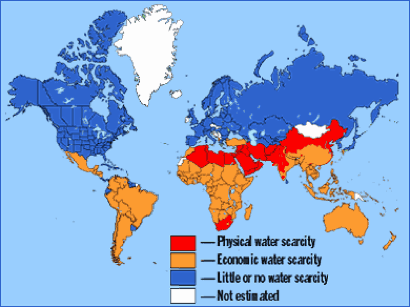
Adequate availability of water, food and energy is critical to global security. Water, the sustainer of life and livelihoods, is already the world’s most exploited natural resource.

With nature’s freshwater renewable capacity lagging behind humanity’s current rate of utilization, tomorrow’s water is being used to meet today’s need.


Consequently, the resources of shared rivers, aquifers and lakes have become the target of rival appropriation plans. Securing a larger portion of the shared water has fostered increasing competition between countries and provinces.

Efforts by some countries to turn transnational water resources into an instrument of power has encouraged a dam-building race and prompted growing calls for the United Nations to make water a key security concern.

More ominously, the struggle for water is exacerbating impacts on the earth’s ecosystems. Humanity is altering freshwater and other ecosystems more rapidly than its own scientific understanding of the implications of such change.

Degradation of water resources has resulted in aquatic ecosystems losing half of their biodiversity since just the mid-1970s. Groundwater depletion, for its part, is affecting natural streamflows, groundwater-fed wetlands and lakes, and related ecosystems.

The future of human civilization hinges on sustainable development. If resources like water are degraded and depleted, environmental refugees will follow.

Sanaa in Yemen risks becoming the first capital city to run out of water. If Bangladesh bears the main impact of China’s damming of River Brahmaputra, the resulting exodus of thirsty refugees will compound India’s security challenges.

Internal resource conflicts are often camouflaged as civil wars. Sudan’s Darfur conflict, for example, arose from water and grassland scarcity.

Turkey is accelerating its diversion of the Tigris and Euphrates rivers

Interstate water wars in a political and economic sense are being waged in several regions, including by building dams on international rivers and by resorting to coercive diplomacy to prevent such construction.

Examples include China’s frenetic upstream dam building in its borderlands, and downriver Egypt’s threats of military reprisals against the ongoing Ethiopian construction of a large dam on the Blue Nile.

Upstream Turkey, inspired by China’s strengthening hydro-hegemony, is accelerating its diversion of the Tigris and Euphrates rivers. This will exacerbate water stress in the two violence-torn, downriver states of Syria and Iraq.

Meanwhile, Israel, with its control of the water-rich Golan Heights and the West Bank aquifers, has leveraged its role as water supplier to Palestinians and Jordanians.

Water as a weapon of war or a tool of terrorism 

The yearly global economic losses from water shortages are conservatively estimated at $260 billion.
Water-stressed South Korea is encouraging its corporate giants to produce water-intensive items — from food to steel — for the home market in overseas lands. This strategy has created a grass-roots backlash against South Korean firms in Madagascar and India’s Odisha state.

A report reflecting the joint judgment of U.S. intelligence agencies has warned that the use of water as a weapon of war or a tool of terrorism would become more likely in the next decade.
Water is a renewable but finite resource. Unlike mineral ores, fossils fuels and resources from the biosphere such as fish and timber, water (unless bottled) is not a globally traded commodity. The human population has doubled since 1970 alone, though, while the global economy has grown even faster.
Consumption growth, however, is the single biggest driver of water stress. Rising incomes, for example, have promoted changing diets, especially a greater intake of meat, whose production is notoriously water-intensive.
In China, South Korea and Southeast Asia, traditional diets have been transformed in the past generation alone, becoming much meatier.

If the world stopped diverting food to feed livestock and produce biofuels, it could not only abolish hunger, but also feed a population larger by four billion, according to a University of Minnesota study.
Compounding the diet-change impacts on the global water situation is the increasing body-mass index of humans in recent decades, with the prevalence of obesity doubling since the 1980s.
Obesity rates in important economies now range from 33 percent in the United States and 26.9 percent in Britain to 5.7 percent in China and 1.9 percent in India.
Heavier citizens make heavier demands on natural resources, especially water and energy. They also cause much greater greenhouse-gas emissions through their bigger food and transport needs.
A study published in the British journal BMC Public Health found that if the rest of the world had the same average body-mass index as the United States, it would be equivalent to adding nearly an extra billion people to the global population, with major implications for the world’s water situation.
The issue thus isn’t just about how many mouths there are to feed, but also about how much excess body fat there is on the planet.
The point to note is that a net population increase usually translates into greater human capital to create innovations, power economic growth and support the elderly, but a net increase in body weight only contributes to state liability and greater water stress.
Preventing water wars demands rules-based cooperation, water-sharing and dispute-settlement mechanisms.
However, most of the world’s transnational basins lack any cooperative arrangement, and there is still no international water law in force. Worse, unilateralist appropriation of shared water resources is endemic where autocrats rule.


Thursday, 24 April 2014

TURKEY


Turkey Ponders Role as Oil Hub

Over the past three years, Turkey has experienced some of the fastest growth in energy demand of countries in the Organization for Economic Cooperation and Development (OECD). Unlike a number of other OECD countries in Europe, Turkey's economy has avoided the prolonged stagnation that has characterized much of the continent for the past few years. The country's energy use is still relatively low, although it is increasing at a fast pace. According to the International Energy Agency (IEA), energy use will continue to grow at an annual growth rate of around 4.5 per cent from 2015 to 2030, approximately doubling over the next decade. 

As of January 1, 2014, the Oil & Gas Journal (OGJ) estimated Turkey's proved oil reserves at 295 million barrels, located mostly in the southeast region. Turkey's oil production peaked in 1991 at 85,000 barrels per day (bbl/d), but then it declined each year and bottomed out in 2004 at 43,000 bbl/d. Although Turkey's production of liquid fuels has increased slightly since 2004, it is far short of what the country consumes each year.

Türkiye Petrolleri Anonim Ortaklığı (TPAO) is the main exploration and production entity in Turkey. As a state-owned firm, TPAO has preferential rights, and any foreign involvement in upstream activities is limited to joint ventures with TPAO. Overall, TPAO produced about 75 per cent of the total oil output in Turkey in 2011, according to the IEA.

The government offers several types of tax breaks to encourage exploration and production, including lower corporate tax rates, exemptions from import duties for material and equipment, and exemptions from value-added tax for exploration activities.

Territorial Disputes 

Most of Turkey's 295 million barrels of proven oil reserves are located in the Batman and Adiyaman Provinces in the southeast (which is also where most of Turkey's oil production occurs), with additional deposits found in Thrace in the northwest. The U.S. Geological Survey estimated about 438 million barrels of oil in as yet undiscovered resources in the southern onshore part of the country. While technically recoverable, it is unclear whether these resources will be economically viable to develop.

Offshore reserves may become a future source of Turkey's oil supply. There may be significant reserves under the Aegean Sea, although this has not been confirmed because of ongoing territorial disputes with Greece. The Black Sea may also hold significant oil production potential for Turkey. The Turkish national oil company, TPAO, has increased its exploration activities in the Turkish portion of the Black Sea, which could hold between 7 and 10 billion barrels of oil. The offshore area is being explored by TPAO, which has formed joint ventures with ExxonMobil and Petrobras. TPAO's short-term goal is to develop the resources situated in the Black Sea. Turkey's Ministry of Energy and Natural Resources plans to begin commercial production in the Black Sea by 2016.

Background Information:

NEW MEDITERRANEAN OIL AND GAS BONANZA


INCREASED DRILLING ACTIVITIES ANNOUNCED IN THE SOUTH EASTERN MEDITERRANEAN BASIN 

Turkey: the transit energy hub?

In addition to the Black Sea, TPAO plans to develop hydrocarbon resources in the Mediterranean. In November 2011, TPAO signed an agreement with Royal Dutch Shell for hydrocarbon exploration in the Mediterranean and the southeast area of the country. This agreement covered plans for shale gas exploration in the southeast near the city of Diyarbakir. According to Turkey's Ministry of Energy and Natural Resources, Shell began exploration at the Saribugday 1 field in August 2012.
In addition to being a major market for energy supplies, Turkey's role as an energy transit hub is increasingly important. Turkey is a key part of oil and natural gas supplies movement from Russia, the Caspian region, and the Middle East to Europe. Background Information:TURKEYS ENERGY GAMBLE http://geopoliticsrst.blogspot.com/2012/07/turkey-and-russia.html

The country has been a major transit point for seaborne-traded oil and is becoming more important for pipeline-traded oil and natural gas. Growing volumes of Russian and Caspian oil are being sent by tanker via the Turkish Straits to Western markets, while a terminal on Turkey's Mediterranean coast at Ceyhan serves as an outlet for oil exports from northern Iraq and for both oil and natural gas exports from Azerbaijan. Approximately 3.0 million bbl/d flowed through the Bosporus and the Dardanelles in 2013 (approximately 2.5 million bbl/d of crude oil and 0.5 million bbl/d of petroleum products). 

Background Information: 
Turkey and Cyprus

TURKEYS SHOW OF FORCE

A terminal on Turkey's Mediterranean coast at Ceyhan facilitates oil exports from northern Iraq via a pipeline from Kirkuk and from Azerbaijan via the Baku-Tbilisi-Ceyhan pipeline. The Kirkuk-Ceyhan pipeline is Turkey's largest oil pipeline (by capacity) and serves as a transport pipeline of Iraqi oil. It is approximately 600 miles long and consists of two lines with a capacity of 1.65 million bbl/d. However, only one of the twin pipelines is operational, with a maximum operational capacity of 400,000 bbl/d, according to the Office of the Special Inspector General for Iraq Reconstruction (SIGIR). In late 2012, Iraq and Turkey agreed to continue crude oil imports through this pipeline for another 15 years, although frequent attacks on the pipeline regularly result in operation disruptions. Actual flows averaged just over 300,000 bbl/d in 2012.

The Baku-Tbilisi-Ceyhan Pipeline (BTC) is Turkey's longest pipeline (approximately 1,100 miles). Its original capacity was 1 million bbl/d, which was increased to 1.2 million bbl/d in 2009 with the use of drag-reducing agents. The pipeline transports Azeri light crude (mainly from the Azeri-Chirag-Guneshli field) via Georgia to Turkey's Mediterranean port of Ceyhan for further export. Since 2008, Kazakh crude oil has also been shipped via the BTC. The crude is then shipped via tankers to European markets. The pipeline initially came into service in June 2006.

Odessa-Brody pipeline in Ukraine

To ease increasing oil traffic through the Turkish Straits and in an effort to anticipate needed increases in pipeline capacity for increasing volumes of Caspian oil, a number of Bosporus bypass options are under consideration in Bulgaria, Romania, Ukraine, and Turkey itself. The BTC Pipeline, which bypasses the Turkish Straits chokepoint, is the first of many planned or proposed bypass pipelines to be constructed.

Bosporus bypass options outside of Turkey include the Odessa-Brody pipeline in Ukraine, which currently transports crude oil into Odessa (reverse mode). Others have not yet been constructed, but proposals include the Pan-European Oil Pipeline, the Bourgas, Bulgaria to Vlore, Albania, and the Bourgas to Alexandropoulos, Greece pipeline.

There were a number of bypass options proposed in Turkey over the past decade, including:

Samsun-Ceyhan Pipeline would transport oil from Turkey's Black Sea port of Samsun to Ceyhan on the Mediterranean coast. The project includes the construction of a 350-mile oil pipeline, a new terminal for receiving oil at Samsun, a terminal for exporting the oil, and a storage plant at Ceyhan. The oil pipeline would have a maximum initial transportation capacity of 1 million bbl/d, which can eventually be increased to 1.5 million bbl/d.
Kiyikoy-Ibrikbaba Pipeline is a 1.2 million bbl/d pipeline that would run between Kiyikoy on the Black Sea and Ibrikbaba on the Aegean Sea near Greece. This pipeline was proposed more than six years ago, but very little progress has occurred.

Canal Istanbul is a proposed 30-mile link between the Black Sea and the Sea of Marmara. The waterway would be located on the European side of the Bosporus and completed by 2023. However, given the size of the undertaking and the associated cost, this project is the least desirable and least feasible option, and likely will not be completed.

Kurdish Regional Government (KRG) Pipeline would connect oil fields in the northeast, KRG-controlled portion of Iraq to Turkey via an independent pipeline from Taq Taq to Fishkhabur. The KRG has already constructed the pipeline with a capacity of 300,000 bbl/d, but Iraq's government has threatened litigation against Turkey for buying KRG oil without official approval.

Ceyhan has become an important outlet for both Caspian oil exports as well as Iraqi oil shipments from Kirkuk

The port of Ceyhan has become an important outlet for both Caspian oil exports as well as Iraqi oil shipments from Kirkuk. Turkey is seeking to build up Ceyhan as a regional energy hub, with private investors receiving approval to build several refineries at the oil terminal, adding revenue beyond transit fees.

The Ceyhan oil terminal has four crude oil loading berths. Two outer berths can accommodate tankers up to 300,000 deadweight tons, while the two inner berths can accommodate ships up to 150,000 deadweight tons. In 2012, Ceyhan handled more than 600,000 bbl/d of Azeri exports and about 300,000 bbl/d of Iraqi crude oil exports to Europe and the United States.

Background Information: 
TURKEY IS ANXIOUS TO GAIN UPPER HAND IN THE REGIONS ENERGY BONANZA 

In addition to crude oil, Iraqi condensate exports have also started to load in Ceyhan. In September 2012, the Kurdish Regional Government trucked the first cargo of condensate from Iraq to Ceyhan, which was loaded onto a vessel on October 4. The size of the cargo was about 105,000 barrels, with additional cargoes already planned to be shipped via the same route.

The Kurdish Regional Government also stated in early 2014 that it would work with the Turkish government to open several new border crossings, increasing the potential volume of exports by truck.